SOLVER Scanning Probe Microscope

Two registration schemes of Scanning Near-field Optical Microscope
Results obtained on SNOM head

SNOM head with non optical tip-sample distance control
("Tuning fork" SNOM head)

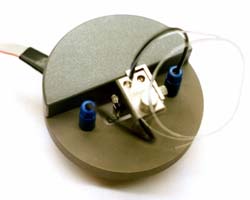
A Shear-force mechanism is widely used to regulate fiber tip-sample separation in SNOM. In our SNOM construction we are using a tuning fork with attached tapered fiber and piezoelectric element to apply lateral vibration to the system: A Q-factor of tuning fork without fiber is commonly 104 2x10⁴ (in air), after attaching the tapered fiber Q-factor decreases to 103 5x10³. Usually a resonant frequency changes weakly (it is about 32 kHz for the first resonant pike and 190 kHz for the second resonant pike). A electrical response of tuning fork is used to control the tip-sample separation and for measuring an AFM profile. At the same time it's possible to record the optic signal from light-conducting fiber by means of photoelectric device or photodiode while the scanning progress. The SNOM resolution capability (AFM-resolution and optical resolution) depends on the light-conducting fiber point curvature radius and on the probe-oscillation amplitude. We have obtained 50nm AFM resolutionSear Force head of Solver-P47
Sear Force head
of Solver-P47

(Shear force microscope) using own light-conducting fiber.

      Main features:

  1. NT-MDT SNOM has non optical feedback control system which consists of tuning fork and light conducting tapered fiber attached to the piezoelectric element apply vibration to the system.
    This gives the following advantages in comparison with optical scheme of registration in Shear Force mode.

    1. More complicated system of registration
    2. The light from the lazer (from shear force system)add the optical noise to the image.
    3. The piezo modulate the fiber, but the fiber resonant frequency depends on the length of fiber which is hard to control.

  2. Minimum amplitude of micro fiber top oscillations is 10 nm.

  3. Maximum AFM resolution 50 nm (depends on curvature radii of micro fiber tip).

  4. Z Resolution: 1-10A

  5. Resonant frequency of system is about 190 kHz ( +/-0,5 kHz) on the second harmonic and the 32kHz at the first one.

  6. NT-MDT-SNOM gives you possibility of using micro fibers of any manufactures.

  7. The microscope has external input which allows to use customer receiving-amplifying equipment.
    The scheme is as the following:

    micro fiber tip output - customer receiving-amplifying
    equipment - NT-MDT-SNOM.
    Ext. Input at:Umax = +5 B
    Umin = - 5 B
    Sensitivity:Umin= (10/216)B (16-bit-DAC)

  8. The SNOM system can be supplied in two configurations:

    1. Scanning by the sample
    2. Scanning by the optical fiber

    In the scanning by the optical fiber system it is possible to measure the samples up to 70x70x20mm (100x100x20 mm) with the possibility of micro positioning at the area of 5mm (15mm) on the sample surface. The positioning can be done with the resolution of 3um and could be observed through optical system with CCD camera.


Copyright © 1998, NT-MDT
Send comments to bykovav@ntmdt.zgrad.ru